
Remembering Naïm Khader
In naming a street after Naïm Khader, Ixelles has done more than honour a murdered diplomat. It has acknowledged that the Palestinian story is part of the story of a vibrant, multicultural Brussels.

(Brussels) - I remember the day Naïm Khader was killed so vividly it could have been last week.
It was 9 am on an ordinary June 1 in 1981 and I was a young reporter on my way to work when I heard the news bulletin announcing his assassination on my car radio.
I pulled over to the side, listened in shock, cried bitterly and then went to my desk and wrote a quick piece about Khader the man and the savvy, charismatic representative in Brussels of the Palestine Liberation Organisation that I was fortunate enough to know.
Given my ongoing work on Gaza and Palestine, I often think of Khader. Memories of our discussions hit me intensely just a few days ago when – on another June 1 - the Commune of Ixelles in Brussels inaugurated a street in honour of Khader.
It is a fitting tribute to a man who so many of us in Brussels have never forgotten. How could we?
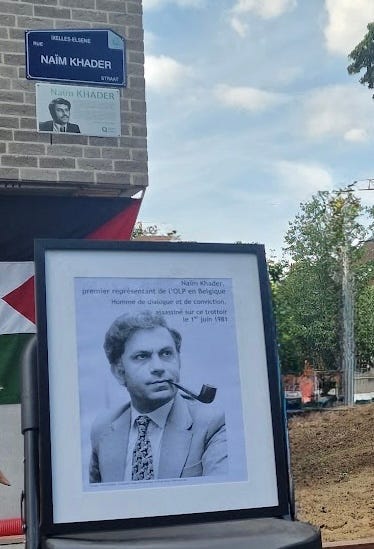
Khader was not only a charming and articulate Palestinian diplomat, he was a bridge-builder who believed in dialogue between Europe and the Arab world at a time when such engagement was still rare. Intelligent and eloquent, with a ready smile, he had the rare ability to persuade without lecturing.
Few media outlets in those days were interested in the Palestinian question. But my editors at the now defunct “Middle East International”, a bi-weekly published in London, wanted the views of what was then the European Economic Community.
Those were the heady years after the EU’s groundbreaking Venice Declaration of 1980 when Europe had dared to articulate a position on the Middle East that recognised both Israel’s right to security and the Palestinians’ right to self-determination.
It felt, at the time, as if Europe might move out of America’s shadow and carve out an independent role in the search for peace. Khader believed deeply in that possibility, in a Europe that could be a force for dialogue, justice and balance.
It was a different Europe and a very different Brussels then. We were a small group of journalists, our briefings with key EU policymakers and visiting ministers were wide-ranging and intimate at the same time. Journalists, diplomats and policymakers often crossed paths in the cafés, corridors and institutions that made up what would later become know as the EU bubble.
Khader was already a well-known figure. He was kind and patient with a young reporter like me and he was a loyal friend. At a time when Palestinians were often portrayed through the lens of conflict and violence, he offered Europeans a different picture of Palestine and challenged prejudices simply by being himself
Perhaps that was his greatest strength. He made it impossible for people to reduce Palestinians to orientalist stereotypes.
Today, after almost three years of Israel’s genocide in Gaza and ethnic cleansing in the occupied West Bank, millions across Europe have understood the cruelty and pain of Israel’s occupation and dispossession of Palestinians.
Hundreds of thousands march in the street to voice their solidarity with Palestinians. Pressure for an end to the EU’s complicity in Israel’s genocide is growing. Europeans understand what our leaders still don’t have the courage to accept: Palestinians’ right to freedom, equality, justice and self-determination.
Khader was 41 when he was hit by six bullets and died on the sidewalk in front of his house in Ixelles. His assassination remains officially unsolved. It is sometimes linked to Israel’s broader campaign of targeted killings of Palestinian figures in Europe in that period, as described in Ronen Bergman’s “Rise and Kill First”. Israel has denied involvement, however, and no one has ever been convicted for Khader’s murder.
Khader did not live to see a free Palestine. But forty-five years after his death, his presence lingers and his values live on in the conversations he inspired, the friendships he forged and the values he embodied.
The names of streets are about memory but also about values because they tell us whose stories deserve to endure and be repeated over and over again.
In naming a street after Naïm Khader, the commune of Ixelles has done more than honour a diplomat murdered in his prime. It has acknowledged that the Palestinian story is part of a vibrant and multicultural Brussels. And that Khader’s legacy will live on.
END
Sukran Shada! A moving testimony
Well done, Shada!